How Professional Tree Removal Metairie Protects Nearby Buildings

A tree rarely fails without warning, but the warning signs are easy to miss if you do not spend your days looking up into canopies, down at root flares, and across rooflines. In Metairie, where mature oaks, pines, water oaks, and ornamental species often stand close to homes, garages, fences, and commercial buildings, tree removal is not just a landscape decision. It is a structural protection measure.
That point becomes clear after a storm, when a limb punches through shingles or a whole stem settles across a carport. Yet the real value of professional tree removal shows up before that kind of damage happens. The safest removals are the ones planned early, while the tree is still standing and the building next to it is still untouched.
Homeowners often think of tree work as chainsaws and cleanup. The technical side is much broader. A qualified crew studies lean, weight distribution, decay pockets, wind exposure, utility clearances, roof geometry, drainage patterns, and access limits. In tight residential lots common across Jefferson Parish, that judgment matters. A poor cut or rushed removal can do nearly as much harm as the failing tree itself.
Why buildings in Metairie face a different level of risk
Metairie has a dense suburban layout. Many properties were built long after the larger trees on the lots had matured, so trunks, roots, and wide branch spreads often occupy the same space as foundations, driveways, porches, and roof overhangs. Add Gulf Coast weather, saturated soil, and frequent wind events, and the margin for error gets small.
A healthy tree can still become a hazard if it outgrows its space. A live oak with a broad lateral limb over a bedroom wing may look stable for years, then fail during a heavy summer storm because a cavity expanded around an old pruning wound. A pine that looks straight from the street may have a compromised root plate on the back side where runoff has been eroding the soil for several seasons. In both cases, the nearby structure is what raises the stakes.
Professional tree removal in Metairie is often about these site-specific risks rather than obvious deadwood. The crew is not simply asking whether the tree is alive. They are asking what will happen if a large section moves two feet in the wrong direction, whether the ground can support equipment without cracking a driveway, and whether the trunk can be dismantled in sections without shock-loading the rigging over a roofline.
The hidden ways trees damage buildings
Most people picture a tree falling directly onto a house, and that certainly happens. But some of the most expensive building damage starts in quieter ways.
Roots are a common issue, especially where a tree was planted too close to a slab, walkway, or underground line. Contrary to popular belief, roots do not usually smash through a sound concrete foundation like a battering ram. What they often do is exploit existing weaknesses, lift nearby flatwork, displace pavers, widen small cracks, and alter drainage around the building. Over time, that can mean standing water near the slab, moisture intrusion, or settlement in problem areas.
Canopies create another class of risk. Limbs rubbing a roof may seem minor, but repeated abrasion strips granules from shingles, damages flashing, and opens access points for water. Overhanging branches also trap moisture by limiting sun and airflow. In our climate, that contributes to moss, algae staining, and premature roof aging. Gutters clog faster under dense canopies, and backed-up water can overflow against fascia and siding.
Then there is impact risk, the dramatic category. Weak branch unions, decay columns, hollow trunks, and storm-loaded crowns can all lead to sudden failure. Buildings suffer from direct strikes, but they also suffer from glancing blows. A limb that catches the corner of a roof may peel shingles, bend drip edge, crack soffits, and twist gutter runs without fully landing on the structure. Homeowners sometimes underestimate this because the damage does not look catastrophic from the yard. Once roof decking and moisture barriers are involved, repair costs rise quickly.
Why removal can be safer than repeated pruning
There is a natural reluctance to remove a mature tree. That makes sense. Shade has value. Privacy has value. Curb appeal has value. In some cases, selective pruning, cabling, or crown reduction can buy years of safe retention. But those are not universal solutions.
If the tree has significant trunk decay, advanced root damage, poor species placement, or a lean toward a structure with limited anchoring support, pruning may only reduce the crown while leaving the core problem untouched. Sometimes repeated trimming creates a false sense of security. The tree looks smaller, so it feels safer, but the decay keeps progressing or the regrowth comes back weakly attached. I have seen properties where owners paid for several rounds of heavy trimming over a decade, only to remove the tree anyway after one wet hurricane season exposed movement at the base.
That is where a seasoned arboricultural judgment matters. A professional does not default to removal, but they also do not treat preservation as a virtue when the structure next door bears the risk. If the cost of ongoing mitigation approaches the cost of a controlled removal, and the chance of failure remains material, removal is often the more responsible decision.
The planning stage is what protects the building
The public usually notices the cutting. The building is actually protected in the planning.
Before any saw starts, an experienced crew looks at the entire drop zone and every object that cannot move. Roof ridges, fences, AC condensers, glass patio doors, pool enclosures, satellite dishes, detached sheds, pergolas, and neighboring structures all shape the removal method. So do soft targets such as ornamental beds, irrigation heads, and pavers that can crack under falling wood or machine traffic.
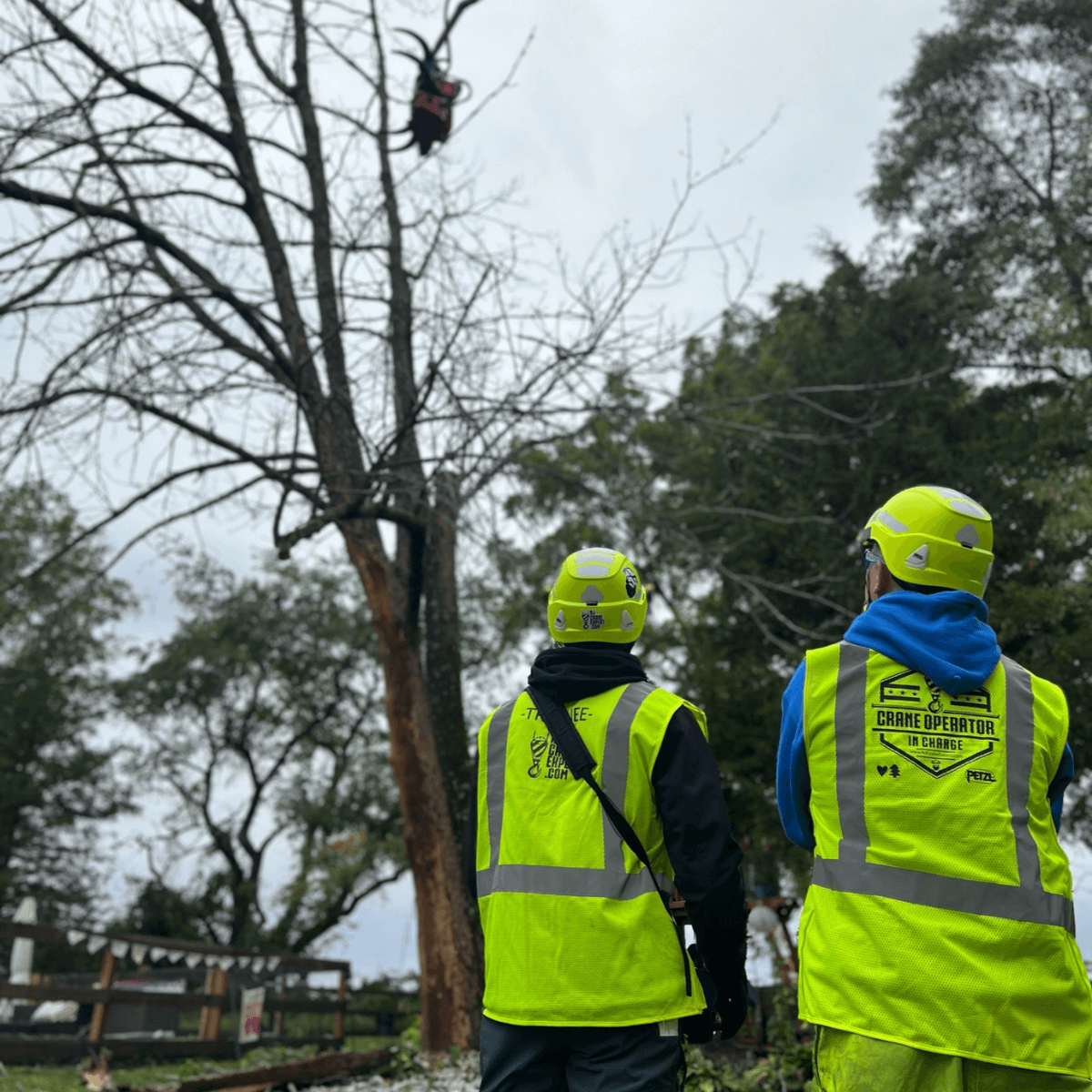
The crew also evaluates the tree itself from several angles. They are looking for compression and tension zones, dead tops, included bark, old topping wounds, fungal fruiting bodies, lightning scars, and asymmetrical loading. A tree over a building is not removed the same way as a tree in an open pasture. In tight quarters, the work is often done piece by piece, with controlled lowering using ropes, rigging blocks, friction devices, and tag lines. Sometimes a crane is the safest answer, especially when the canopy extends far over a roof and there is no clean drop zone below.
One of the clearest signs of professionalism is restraint. Good crews do not force a simple method onto a complicated site. If a bucket truck cannot reach without damaging the yard or coming too close to overhead lines, they switch approaches. If the tree is too compromised to climb safely, they bring in a crane or other specialized support. Buildings are protected when ego stays out of the work.
How sectional dismantling prevents roof and wall damage
On a constrained residential lot, professional removal usually means sectional dismantling. Instead of felling the whole tree, the crew disassembles it from the crown down. This sounds slower because it is slower, and that extra time is precisely what protects nearby buildings.
A climber or lift operator will strip smaller limbs first, reducing the sail effect and making the remaining structure more predictable. Each piece is cut to match the available space below and the rigging capacity above. If a branch extends over a garage roof, it may be tied, balanced, cut, and lowered in a controlled arc rather than dropped. If the limb is long and heavy, it may be cut in smaller picks to keep the swing radius tight and prevent shock on the rigging point.
The trunk is handled the same way. Once the canopy is off, the stem can be taken down in blocks. Each section is either dropped into a safe zone or lowered. The difference between a disciplined removal and a careless one is often measured in inches. I have watched crews land trunk rounds into a gap no wider than a compact car parking space, between a fence line and a slab, because the site allowed nothing larger.
That precision protects more than shingles. Vibrational damage matters too. Large uncontrolled drops can crack brittle concrete, shift pavers, and bruise shallow utility runs. Professional crews think about force transfer, not just impact.
Roofs are only part of the equation
When people think about tree removal near buildings, they naturally focus on the roof. Roofs are vulnerable, but the problem set is wider.
Siding and masonry can be scraped or punctured by moving branches during a poorly controlled cut. Windows break from side-swinging limbs that were underestimated. Chimneys and vent stacks are frequent near-miss points because they project above the roof plane and create snag hazards during lowering. Carports and patio covers are another weak area. They are often less robust than the main structure and can collapse under loads that a roof frame might survive.
Access routes matter just as much. A heavy truck crossing the wrong section of driveway can crack concrete. Outriggers placed carelessly can sink into soft ground and transfer load unevenly. A stump grinder used too close to shallow utility lines or irrigation can cause secondary repair costs that frustrate homeowners long after the tree is gone.
This is one reason experienced contractors spend time discussing logistics with the property owner before work begins. The conversation should cover where equipment will enter, how debris will be staged, what surfaces need protection, and whether neighboring property access is required. Good communication is part of structural protection.
Storm damage changes the risk picture
After a storm, trees that looked manageable can become unstable in ways that are not obvious from the ground. tree removal metairie A partially uprooted tree may still be standing, but the soil on one side of the root plate has already lifted. A cracked limb can remain suspended high in the canopy, held by fibers that may fail during cleanup. A trunk with spiral damage may look intact while internal wood is badly compromised.
This is when amateur removal attempts become especially dangerous to both people and buildings. Storm-loaded trees store energy. Cuts that would be routine in a healthy tree can behave unpredictably when the stem is bent, twisted, or hung up in another canopy. I have seen homeowners cut pressure wood on a leaning tree and watch the butt kick sideways toward a fence and shed. That kind of movement is hard to anticipate without training.
Professional tree removal Metairie crews treat storm work with more caution, not less. They often start by stabilizing the work area, clearing small debris for visibility, and identifying tension points before they cut. If the tree is resting on a building, the sequence becomes even more critical. Removing the wrong section first can shift weight onto the structure and increase damage. Controlled relief cuts, support rigging, and sometimes cranes are the safer path.
What a qualified crew looks for before recommending removal
Not every risky tree should come down immediately, and not every leaning tree is failing. The judgment comes from context. A professional assessment usually weighs several factors at once:
- The tree’s structural condition, including decay, cracks, root issues, and branch attachment quality.
- The target value, meaning what the tree could hit, such as a home, detached garage, fence, or neighboring roof.
- The likelihood of failure, based on species traits, recent weather, soil conditions, and visible defects.
- The feasible mitigation options, including pruning, support systems, monitoring, or removal.
- The access and removal complexity, which affects how safely the work can be done without collateral damage.
That last point often gets overlooked by property owners. A tree may be removable in theory, but if access is narrow and the structure is close, the method matters as much as the diagnosis. This is why estimates can vary. One company may price for a simple climb-and-drop approach that is not really appropriate for the site, while another includes rigging protection, roofline control, and equipment mats. The cheaper number is not always the safer number.
The role of cranes and specialized equipment
There is a common misconception that cranes are only for giant trees. In reality, cranes are often about location, not size. A medium-sized tree growing over a house with no drop zone can be a better crane candidate than a huge tree in an open lot.
A crane allows sections to be lifted vertically, reducing swing and eliminating the need to lower every piece through a maze of obstacles. On the right site, this can reduce risk to roofs, fences, pools, and landscaping while also shortening the work window. The trade-off is cost and the need for adequate access and setup space. Not every residential lot can accommodate a crane without additional planning.
Other equipment can be just as important. Ground protection mats preserve lawns and reduce rutting. Compact loaders move debris without repeated dragging across hardscape. Rigging devices manage friction and load control. Even something as basic as plywood shielding over delicate surfaces can make a difference when crews are moving brush near windows or decorative stone.
Professionalism often shows up in these practical details. The building is protected not by one dramatic act, but by a series of smart choices that reduce the chance of incidental damage.
Why insurance and liability should never be an afterthought
When a tree stands close to a building, the financial stakes go up. That makes insurance more than a paperwork issue. A legitimate tree service should carry appropriate liability coverage and workers’ compensation. If a limb breaks a skylight or a worker is injured on the property, you do not want to find out after the fact that the crew was underinsured or uninsured.
Homeowners should also understand that general handymen or untrained laborers may offer tree cutting at a lower price, especially after storms. The problem is not just workmanship. It is exposure. If the job goes wrong and a roof, wall, or neighboring structure is damaged, disputes become expensive quickly. The savings from the low bid vanish the moment structural repair enters the picture.
A reputable contractor will usually explain how they plan to protect the property, what equipment they intend to use, and what limitations the site presents. That conversation matters. If the answer is vague, or if the contractor dismisses the complexity of the job with too much confidence, that is a warning sign.
A practical example from a tight suburban lot
Consider a common Metairie setup: a broad-canopied oak in the rear corner of a lot, with limbs extending over a single-story roof, a wooden privacy fence, and an outdoor condenser unit. The homeowner notices occasional limb drop and one visible dead leader after a windy spring. At ground level, the tree still appears vigorous. The temptation is to remove the deadwood and postpone a bigger decision.
During a professional inspection, the crew finds a cavity at a major union and evidence of old storm failure that compartmentalized poorly. The trunk lean is modest, but the canopy mass is concentrated toward the house. The rear yard has no clear drop zone, and the gate is too narrow for large equipment. The removal plan becomes a controlled climb with rigging from a neighboring access point, tree removal metairie protection around the condenser, and sectional lowering away from the roof edge.
Without that plan, a do-it-yourself attempt might involve cutting limbs and letting them swing free, where they could easily bounce off the fence, roll into the AC unit, or drag across the shingles. With the proper method, the building and site improvements stay intact. The difference is not luck. It is process.
Timing matters more than many owners realize
Once a tree begins to decline, waiting usually does not make removal easier. It often makes it harder and riskier. Dead limbs become brittle and unpredictable in the rigging. Climbing options narrow as wood quality worsens. Root issues can progress after wet periods, especially when trees are already stressed. Access can also become worse if a partial failure blocks the yard or damages a fence line.
There is a sweet spot for safe removal, when the hazard is identified early enough that the tree can still be dismantled under controlled conditions. Delaying until after storm season may mean the same tree now requires emergency pricing, additional equipment, or more invasive access just to remove it without hitting the building.
For property managers and homeowners alike, this is where regular inspections earn their keep. A brief site review after major storms, or when you notice fresh lean, soil heaving, cracked limbs, or branches contacting the structure, can prevent much larger costs later.
When removal also improves the building envelope
Not every benefit of removal is about immediate danger. Sometimes taking out the right tree improves the building’s performance over time. A roof that stays damp under dense shade may dry more consistently once the canopy is gone. Gutters may stop overflowing. Siding can last longer with better airflow and reduced organic buildup. In some cases, foundation moisture conditions improve when a problematic root system and poor drainage pattern are addressed together.
That does not mean every nearby tree is bad for a building. Far from it. Well-placed trees provide shade, reduce heat load, and add value to a property. The issue is fit. A tree that works beautifully in one part of a yard can be a long-term problem when it is five feet from the house and thirty feet over the roof.
What homeowners can do before calling for tree removal
You do not need arborist training to notice early warning signs. A homeowner can make a useful first pass by observing the relationship between the tree and the structure. Pay attention to new roof contact, recurring gutter clogging from one overhanging section, mushrooms or decay at the base, fresh cracks in major limbs, or exposed roots lifting nearby hardscape. After storms, look for subtle changes, such as a new lean or mounded soil on one side of the trunk.
When you call for an estimate, having a clear record helps. Photos taken over time can show whether a lean has changed or whether a crack is widening. Point out any prior limb failures, roof repairs, or drainage issues near the tree. This gives the contractor better context and helps them recommend the safest path.
If you want a simple rule of thumb, keep this checklist in mind:
- Any tree touching the roof deserves prompt evaluation.
- Any tree with visible trunk decay near a building should be treated as a higher priority.
- Any recent lean, root plate movement, or large cracked limb after a storm warrants professional attention.
- Any removal near power lines requires specialized handling and, in many cases, utility coordination.
- Any estimate that ignores property protection details should be viewed cautiously.
Professional tree removal is often judged by what people see at the end of the day: a clean yard, stacked logs, and a missing tree. The better measure is what remains untouched. The intact roof. The unbroken windows. The fence still standing straight. The driveway without cracks. In a place like Metairie, where trees and buildings live close together, that kind of outcome does not happen by accident. It comes from planning, controlled execution, and an honest understanding of how wood, gravity, weather, and structures interact.
A Perfect Cut Tree Service
4725 Shores Dr, Metairie, LA 70006
+1 504-732-0779
FAQ About tree removal metairie
What is the average cost of tree removal in my area?
There is no single price that fits every tree. Size, condition, access, nearby structures, equipment, debris hauling and stump work affect the estimate. Request a written, site-specific quote that identifies what is included.
Who will remove trees for free?
Free removal is not generally available for ordinary private-property tree work. Utilities or public agencies may handle trees within their responsibilities. Confirm eligibility directly and do not assume that an offer or assistance program covers your tree.
Can I just cut down a tree in my yard?
Check ownership, location and local requirements first. Jefferson Parish requires a permit for removal of qualifying vegetation in the public right-of-way, and additional protections may apply in designated areas. Ask the parish about your property and have a qualified tree professional assess the work.